The U.S. Department of Transportation has finalized a new rule requiring airlines to provide passengers with a clear, one-page summary of compensation and customer service policies when travel disruptions occur.
Published in the Federal Register on April 24, 2026, the rule takes effect May 26, 2026, and requires covered airlines to submit the summary to DOT before posting it prominently on their websites within 90 days.
The document must outline passenger rights and airline obligations in six areas: flight delays, diversions, cancellations, mishandled baggage, voluntary seat relinquishment due to overbooking and involuntary denied boarding.
The rule implements Section 429 of the FAA Reauthorization Act of 2018, legislation intended to make airline compensation and refund policies more transparent after years of being embedded in lengthy contracts of carriage.
However, airlines will not be required to comply until DOT completes a separate approval process under the Paperwork Reduction Act and publishes a follow-up Federal Register notice confirming approval from the Office of Management and Budget. Once finalized, airlines will have 90 days to post the disclosures.
Redevelopment at Bangkok Suvarnabhumi Airport
BINGHAMTON, NY – May 1, 2026 – Airports of Thailand (AOT) has awarded SureScan a contract to support the redevelopment of a portion of the Hold Baggage Screening (HBS) system at Bangkok Suvarnabhumi Airport (BKK), following project approval from AOT. The initiative forms part of the airport’s broader infrastructure enhancement efforts aimed at strengthening aviation security capabilities while supporting continued operational efficiency at one of Southeast Asia’s busiest aviation hubs.
Under the agreement, SureScan will deploy its advanced x1000 system to support the modernization of a segment of the airport’s existing HBS infrastructure. The upgrade will enhance screening performance while supporting the airport’s long-term operational and sustainability objectives.
Following the award of the HBS project, the advanced capabilities of the x1000 system are expected to deliver enhanced detection performance, improved energy efficiency and long-term operational reliability at Bangkok Suvarnabhumi Airport. The system is designed to support high-throughput baggage screening environments; the system enables airports to maintain stringent security standards while efficiently managing increasing passenger volumes.
The project supports Bangkok Suvarnabhumi Airport’s ongoing commitment to strengthening aviation security standards while optimizing lifecycle costs and improving system sustainability. By integrating next-generation screening capabilities, the airport continues to advance its modernization program and reinforce its position as a leader international aviation hub in the region.
“Bangkok Suvarnabhumi Airport plays a critical role in regional and international air travel, and we are proud to support Airports of Thailand in advancing its hold baggage screening capabilities,” said Henry Vitali, CRO of SureScan Corporation. The deployment of the x1000 system will help deliver improved detection performance, operational efficiency, and long-term reliability, ensuring the airport is well equipped to meet evolving security requirements and future passenger growth.”
The project contributes to the continued modernization and performance enhancement of the airport’s security infrastructure, supporting AOT’s broader vision of maintaining world-class aviation safety standards while ensuring efficient and sustainable airport operations.
About SureScan
SureScan Corporation has pioneered next-generation CT and X-ray screening technologies using CZT detectors, with products deployed worldwide since 2017. With comprehensive offerings across Checked Bag, Checkpoint, and Cargo security, SureScan is committed to shaping the future of global security through innovation, precision, and reliability. SureScan anticipates a bright future and looks forward to expanding our team to support the opportunities created by augmenting our technology with our new TRS offering. Learn more at home – SureScan Corporation
The Dubai Civil Aviation Authority has introduced a new regulatory framework designed to enhance passenger rights and improve airline accountability. The directive establishes clearer service obligations, introduces structured complaint‑handling procedures, and supports a digital tracking system to increase transparency across the passenger journey. Arabian Business
On April 22, 2026, Frankfurt Airport has opened its state-of-the-art Terminal 3, which aims to serve up to 19 million passengers per year with three boarding gates. To get the terminal ready for operation, new security lanes were also equipped with millimeterwave scanners from Rohde & Schwarz. The decision to select the QPS201 and QPS Walk2000 models promises not only faster passenger flows but also the latest in both security and comfort.
The new major airport section is one of the most advanced infrastructures in Europe. In addition to clear routing, digital services and improved public transport links, operator Fraport is focused on the efficiency of security checks. Rohde & Schwarz was therefore commissioned to install 17 of its QPS201 security scanners and two QPS Walk2000 scanners in the terminal’s security lanes.
The QPS201 security scanner combines high-resolution millimeterwave technology with AI‑powered analysis algorithms. It reliably detects prohibited items with a false alarm rate significantly below regulatory requirements. Image analysis is almost entirely automated, so security personnel only have to check the areas that have actually set off the alarm. This significantly reduces time spent on subsequent checks per passenger and increases the throughput rate of each lane while maintaining the same level of security. More than 2,000 of these systems are currently in use around the world.
The new terminal also features two new QPS Walk2000 scanners, which allow passengers to walk through at a normal pace. The QPS Walk2000 completely eliminates the hassle of having to adopt a fixed pose, as required by traditional scanners.
It not only brings down the average dwell time per passenger but also ensures a low false alarm rate thanks to the highest data quality and most advanced algorithms. For the operator, Fraport, this means increased capacity utilization of the new security lanes, fewer follow-up checks and an overall more reliable security process. For passengers, these scanners mean faster and more comfortable security checks before takeoff.
All scanners have the required approvals from the European Civil Aviation Conference (ECAC), the US Transportation Security Administration (TSA) and other national authorities, emphasizing their regulatory compliance and international applicability. By integrating Rohde & Schwarz scanners, Frankfurt Airport is showing that state-of-the-art technology and seamless passenger processes can go hand in hand.
Twenty-two Sri Lankan monks were arrested with 110kg (242lbs) of cannabis hidden in their luggage. Customs officials at the Colombo International Airport in Sri Lanka said each monk was found with around 5kg of kush, a very potent form of the drug, hidden in their luggage behind “false walls” upon their arriveal in the city on Saturday, April 24.
The monks were mainly students and were returning from Thailand after being treated to an all-expense-paid four-day holiday by a sponsor when they were detained. The sponsor remains unnamed.
A Delta flight from Atlanta to Portland was more eventful than usual on Friday night, April 24 when a woman went into labor mid-flight. The routine flight turned into a full baby delivery during the five-hour flight.
According to news reports, Delta flight 478 was already dealing with one medical situation when a pregnany woman suddenly announced she needed to push. As chance would have it, several medical professionals were on board, and within moments, the cabin became an improvised delivery room with flight attendants helping whenever they could.
EMT Tina Fritz told a news reporter they had no proper medical kit or blankets. Passengers stepped in, offering what they could, while a flight attendant cut his shoelace to tie off the umbilical cord. The whole process went quickly and smoothly. “Within three really good pushes, the baby was out and doing perfect,” Fritz said, describing the mother as “a rock star.”
The baby was delivered safely around 30 minutes before landing, and as the aircraft touched down in Portland, the entire cabin erupted into applause. Emergency crews met the aircraft on arrival, confirming both mother and baby were in stable condition, with Delta later thanking the crew and onboard medical volunteers for stepping in during what turned into an unforgettable flight.
Analogic Corporation and Leidos, Inc, announced a definitive agreement to create a global security imaging and detection company through the combination of Analogic with Leidos’ Security Enterprise Solutions, Ports & Borders and Industrial Automation businesses (SES). The transaction is expected to close in the second half of 2026, subject to customary closing conditions and regulatory approvals. Upon closing, the combined business will operate under the Analogic brand as a privately held company, led byTom Ripp, Analogic’s current chief executive officer.
“Today marks an important milestone for our company and for the security industry. By combining two highly complementary organizations, we are creating a stronger, more capable company with the expertise and breadth of solutions to better meet evolving customer needs worldwide,” said Ripp. “This transaction expands our product portfolio and sales channels, enabling us to support global customers across the full lifecycle of security screening. Customers will benefit from simplified engagement, deeper domain expertise, and solutions that are better aligned with their operational and regulatory requirements. Together, we are better positioned to innovate and support airport, port, and border security customers as they address increasing security demands while maintaining passenger throughput and operational efficiency.”
Analogic is a technology focused company in advanced imaging, power and motion control technologies serving the aviation security, medical nand industrial end-markets. The company has pioneered breakthroughs for nearly six decades, including the commercialization of CT in aviation security applications. Today, Analogic sells imaging and detection and power & automation solutions to customers worldwide.
Leidos SES is a global leader in mission critical security detection systems, with an end-to-end portfolio of products at the world’s busiest airports, ports, borders and critical facilities. With security systems deployed across 129 countries, SES has a proven track record and longstanding customer partnerships.
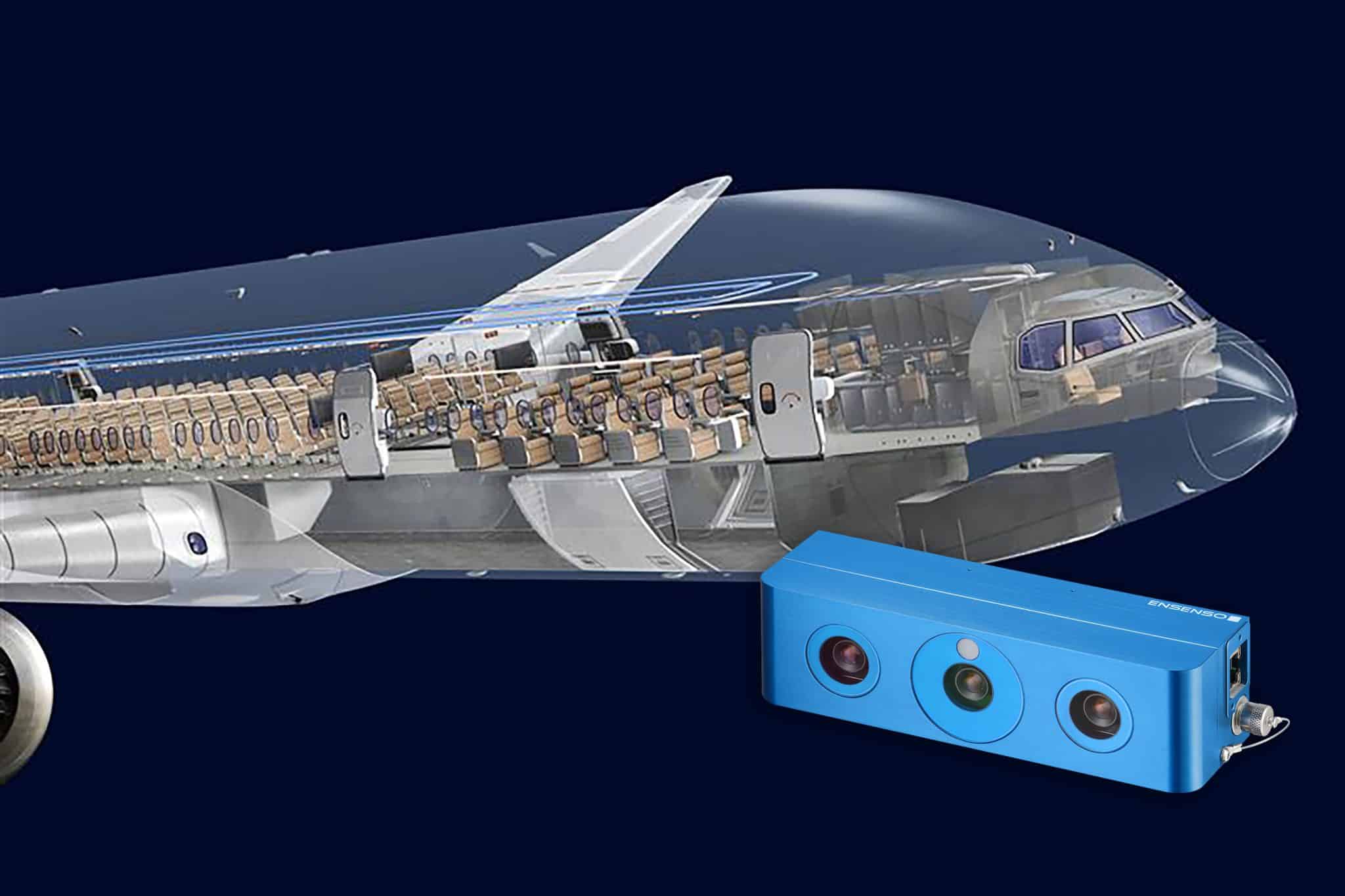
An Ensenso 3D camera integrated into an automated process chain ensures accurate detection and alignment of drilling positions in aircraft cabin assembly.
In modern aircraft production, precision is everything. Every hole and every fixing point must be precisely positioned to ensure safety and quality. As part of the DiCADeMA project (Digital Cabin Architectures and Design for Manufacturing) led by the German Aerospace Centre (DLR), a novel, fully digitally networked process has been developed. Through intelligent automation, this approach elevates aircraft cabin manufacturing to a new level. A key component in this process is an Ensenso 3D camera from IDS Imaging Development Systems GmbH, which ensures highly precise detection and alignment of drilling positions.
Digital process chain from design to production
The aim of the project is to establish a continuous digital thread from design to production. Changes to the cabin design, such as seat spacing and the associated new position of the luggage compartments, are recorded directly in the digital design data and automatically transferred to production planning. Simulations allow these variants to be validated before any physical component is manufactured. Once digital validation is complete, production can begin immediately.
To make this digital process tangible, an automated system for marking drilling positions was developed on a mock-up of an aircraft frame structure. Several networked systems work together in this setup: An autonomous mobile robot (AMR) approaches the frame and positions itself near the target area. Mounted on the AMR is a lightweight robot that moves the marking unit, including the 3D camera, into the acquisition position. At this point, the Ensenso camera takes over the fine alignment. An integrated Manufacturing Execution System (MES) controls all sub-processes.
The role of the 3D camera
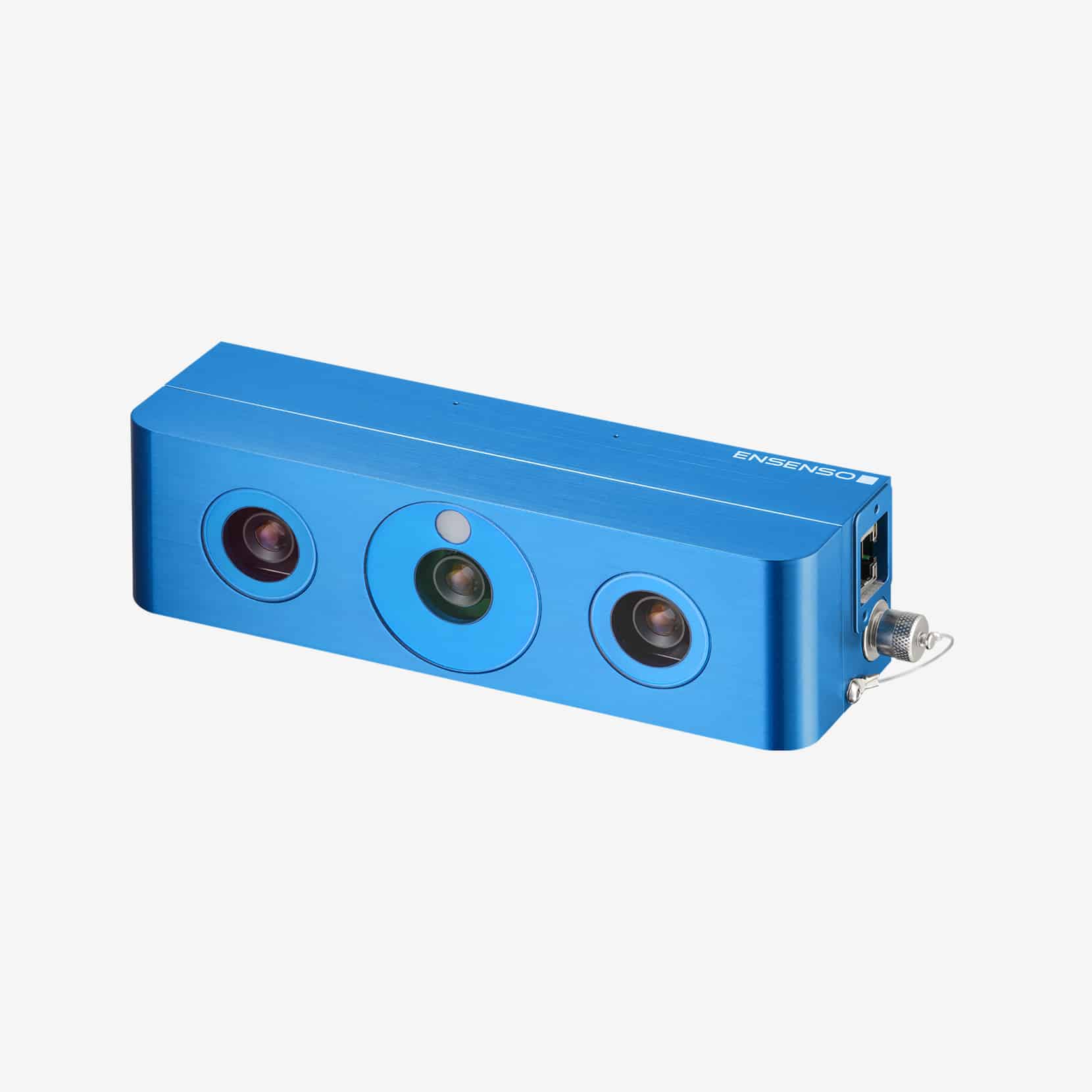
The camera used, an Ensenso N36, captures the environment as a three-dimensional point cloud and ¼ matches it against the CAD data of the aircraft frame. In this way, even the smallest deviations between the target model and the actual geometry can be detected. The system uses this data to calculate precise correction values, which are transmitted to the higher-level MES. Communication takes place via a standardised OPC UA interface, ensuring reliable and secure data exchange between the camera, the robot and the control system. The MES translates the acquired data into concrete control commands for the robot, which then performs the marking of the drilling position.
The autonomous robot achieves a positioning accuracy of around five millimetres. This allows the camera to reach the acquisition position without risk of collision.
The Ensenso camera becomes a key link between digital design and real-world manufacturing: It recognizes local geometries, in this case several rivets and the surface on which they are set and compares the captured point clouds with the reference data from the CAD. This comparison is made possible, among other things, by hand–eye calibration and an iterative minimisation process. The result is a transformation matrix that precisely describes the correction required for the drilling position. By applying this correction value, the drilling position can be set precisely.
An operator follows the vehicle and drills the hole immediately afterwards at the marked spot. This process is repeated for each installation point, while robots and humans can work safely in close proximity to one another.
For this application in aircraft manufacturing, a compact camera with a very short working distance is required in order to keep the path from the acquisition position to the drilling position as short as possible. This helps to maintain high accuracy and avoids excessive robot movements. The Ensenso N36 meets these requirements. The Ensenso N series has been specially developed for use in demanding environmental conditions. Thanks to its compact design, the camera can be installed in a space-saving manner, either in a fixed position or mounted on a robot arm. This makes it equally suitable for 3D capture of both moving and stationary objects. The integrated projector ensures high-contrast texture even under challenging lighting conditions: It projects additional structures onto the object surface using a pattern mask with a random dot pattern, thereby supplementing missing or weak features. All cameras are pre-calibrated at the factory and can therefore be put into operation quickly and easily.
Benefits for manufacturing
The digital process offers the DLR several advantages. Camera-based alignment significantly increases precision and repeatability. At the same time, continuous data acquisition enables complete documentation and traceability of all process steps. Assembly personnel are relieved, as the robot takes over the time[1]2/4 consuming task of position determination, allowing skilled workers to focus on the actual assembly operation.
In addition, production times are significantly reduced, as manual measurements or readjustments are no longer necessary.
Outlook
The demonstration on the mock-up clearly illustrates the potential that lies in combining the digital process chain, robotics and 3D image processing. In further project steps, the accuracy of the system and the performance of the evaluation algorithms will be examined in greater detail. This will involve not only the camera itself, but also the optimisation of the mathematical methods used to align nominal and actual point clouds.
What is currently being tested in aircraft manufacturing may also be applied in other industries in the future. The system impressively demonstrates how optical sensor technology and intelligent Software are paving the way for a new era in manufacturing: networked, efficient and precisely on target.
The German Aerospace Centre (DLR) is the Federal Republic of Germany’s research centre for aerospace. Its research and development work in aviation, aerospace, energy, transport and security is integrated into national and international collaborations.
GRAYHILL, a manufacturer of ruggedized human-machine interface (HMI) solutions, announced the launch of the VP Series VectorPad, a compact directional keypad designed for demanding environments where space is limited and performance cannot be compromised.
Engineered for integration into embedded systems, displays, and control boards, VectorPad delivers IP67 sealing (with proper mating geometry), discrete output simplicity, and up to 1,000,000 cycles per key. The result is a durable, tactile navigation solution optimized for harsh industrial and defense applications.
1. Compact Footprint, Full Performance With a rough frame of just 1.6 in. (41 mm) square, VectorPad enables miniaturized system designs without sacrificing tactile response or operational reliability. Landmark tactile features support blind operation, even in gloved or low-light environments. VectorPad is particularly suited for:
Rugged embedded systems
Defense and secure communications equipment
Industrial control panels
Off-highway and mobile equipment
Non-touch display navigation interfaces
2. A Platform for Scalable HMI Integration Beyond its standalone capabilities, VectorPad serves as a scalable building block for expanded GRAYHILL HMI solutions, including customized housings, integrated display assemblies, and tailored tactile configurations.
“VectorPad is more than a rugged directional keypad, it’s a building block for scalable HMI solutions,” said Ethiene Narvaez, Business Development Leader, Military Solutions at GRAYHILL. “It performs exceptionally as a standalone interface, but it also serves as a foundation for deeper integration, including displays, housings, and fully customized assemblies. It’s designed to grow with our customers’ programs and strengthen longterm partnerships.”
A series of preventable failures within the aviation sector — including manufacturing‑related safety concerns and cyber‑exposed operational systems — has reignited debate around regulatory oversight and industry accountability.
Investigators note that even isolated incidents can have disproportionate effects on public confidence, airline operations, and international connectivity. The latest findings highlight gaps in quality assurance, supply‑chain verification, and digital system hardening.
Aviation security experts are urging regulators to adopt more proactive auditing models, expand cybersecurity requirements for OEMs and operators, and strengthen reporting mechanisms to ensure early detection of systemic risks.