Leidos and Quadridox Partner to Make Baggage Screening More Accurate and Efficient

By integrating their computed tomography (CT) and X-ray diffraction imaging (XRDI) systems into a new offering, Leidos and Quadridox are developing an advanced checked baggage screening technology aimed at increasing security while keeping luggage moving quickly during the screening process.

The new agreement combines Leidos’ Examiner 3DX CT with Quadridox’s DELPHI XRDI technology. By leveraging the companies’ expertise, airports can gain deeper insights into potential threats and be better positioned to keep pace with evolving regulatory requirements.

“Separately, these technologies provide high levels of threat detection,” said Nik Karnik, vice president and Global Security Products division manager within Leidos’ Commercial & International sector. “When integrated, we aim to deliver a powerful and more comprehensive security screening solution to help keep air travel safe.”

The technology integration is designed to help airport operations achieve higher detection rates for prohibited items concealed within baggage, along with fewer false positives. Such advancements will help airports keep up with increasing passenger volume, ensuring luggage can be efficiently screened and routed to flights, on time.  

”By combining XRDI and CT technologies with state-of-the-art AI-based algorithms, it enables a new era of threat detection,” said Joel Greenberg, president and CEO of Quadridox. “This partnership is exciting and goes beyond enhancing the efficiency and automation of checked baggage screening today, we are looking ahead to ensure our systems are ready for next-generation standards.”

The integrated CT and XRDI system has undergone significant internal testing, achieving high performance results while maintaining baggage analysis speed. Data collection at internal and government sites, along with the development of new detection algorithms, are currently underway ahead of a planned airport trial in 2026.

London Biggin Hill Airport Unveils Major Runway Enhancement 

London Biggin Hill Airport has completed a milestone runway resurfacing project. The work, achieved with the support of an eight-figure funding package from HSBC UK, marks a key phase in the airport’s ongoing investment to enhance operational resilience and deliver smoother, more predictable arrivals for business aviation customers. 

Following a summer of work, London Biggin Hill’s runway now boasts a brand new grooved surface along with advanced LED and centreline lighting to increase the visual cues and situational awareness for pilots. These improvements ensure the runway continues to meet the needs of modern business aviation and reinforce the airport’s role as a resilient port of entry for London.  

Robert Walters, commercial director, London Biggin Hill Airport, says: “This resurfacing project is a significant step in our ongoing investment in the airport’s core infrastructure. By enhancing the runway’s durability and performance, we’re giving operators clearer guidance and a more predictable arrival experience. Business aviation customers value confidence in their planning, and this work reflects our commitment to evolving the airport around the needs of pilots flying into the capital. We would like to thank HSBC UK for their ongoing support, without which the project would not have been possible.” 

Ian Scott, relationship director, HSBC UK, commented: “It is fantastic to play our part in helping London Biggin Hill go from strength to strength. The results of the runway resurfacing project will undoubtedly increase confidence and trust in the airport’s ability to deliver for its customers, which will bring greater economic benefit to both the local area and the UK. We look forward to continuing our productive relationship with London Biggin Hill as it continues to develop.” 

Alongside the resurfacing, London Biggin Hill has introduced a 24/7 AUTO-METAR service, providing continuous live weather data, and an enhanced Instrument Runway Visual Range (IRVR) system offering more precise visibility readings. These updates provide flight crews with clearer operational information to support fully informed decisions ahead of arrival.

Kiteworks CISO Warns: National Security Data Is No Longer Protected by Network Boundaries

As national security operations become increasingly distributed and data moves across agency, contractor, cloud, and coalition networks, perimeter-based security models are no longer sufficient to protect mission-critical information, according to new insights from Frank Balonis, chief information security officer and senior vice president at Kiteworks.

Balonis’s analysis, supported by findings from the newly released Kiteworks 2025 Data Security and Compliance Risk: Data Forms Survey Report, reveals that sensitive data frequently travels far beyond the networks designed to safeguard it.

“The boundary you spent years fortifying ends long before your data stops traveling,” said Balonis. “A mission file created inside a secure government enclave may touch systems administered by contractors, cloud providers, and foreign partners. Your perimeter protections don’t go with it.”

Survey Shows High Incident Rates Despite Heavy Security Investment

The report examined how 324 organizations secure their most sensitive data-collection workflows and found:

  • 88% experienced at least one form-related security incident in the past two years
  • 44% suffered a confirmed data breach tied specifically to form submissions
  • 89% use web application firewalls
  • 92% rely on server-side validation
  • 82% deploy parameterized queries to prevent injection attacks

Despite widespread use of perimeter and platform defenses, incidents continue to rise.

“The perimeter looks solid on paper, yet attackers continue to reach the data,” Balonis said. “That’s because our controls sit at the edge of the network, not inside the data as it moves across organizations.”

The Hidden “Long Tail” of National Security Data Exposure

The survey found that low-volume workflows often collect some of the most sensitive information. In national security environments, these include:

  • Base-level administrative portals
  • Niche mission tools
  • Contractor-hosted systems
  • Coalition applications

“Individually, these systems seem minor. Together, they form a parallel network of mission-critical data that rarely sits behind your best-engineered perimeter,” Balonis said.

Why Network Boundaries No Longer Protect National Security Data

According to Balonis, two structural issues make perimeter security insufficient.

Controls do not follow the data. Mission files frequently cross into other environments—contractors, cloud platforms, allied networks—where governance and enforcement differ significantly.

“Once your data leaves the boundary, you’re relying on someone else’s security stack,” said Balonis. “That assumption breaks down quickly in multi-agency and multinational operations.”

Detection outpaces containment. While 82% of organizations have real-time monitoring, fewer than half have automated response capabilities. “You can’t stitch together a cross-agency response fast enough to stop the spread,” Balonis noted. “Attackers take advantage of that delay.”

What National Security Stakeholders Now Prioritize

Respondents placed the highest importance on:

  • Data sovereignty and residency
  • Validated cryptographic controls
  • Certifications such as FIPS 140-3, FedRAMP, ISO 27001, and SOC 2

“These are not perimeter concerns — they’re data properties,” said Balonis. “Which keys protect this file? Where does it reside? Can we prove these facts to auditors? Firewalls can’t answer those questions.”

Making Security Travel With the Data

Balonis outlines four practical strategies for embedding security directly inside national security data.

Object-Level Encryption

Mission files remain encrypted as discrete objects, using FIPS-validated modules, no matter where they travel.

Embedded Policy and Classification

Access rules, caveats, and sovereignty constraints stay with each file and enforce themselves wherever the file moves.

Per-File Audit Trails

Every interaction — access, sharing, forwarding, cross-border movement — is logged for CMMC, FedRAMP, and national-level oversight.

Zero Trust at the File Layer

Each attempt to open or share a file is evaluated in real time based on identity, device, location, and mission context. “The only perimeter that matters now is the file,” Balonis said. “If encryption, policy, sovereignty controls, and audit don’t travel with the data, they won’t be there when you need them.”

The Way Forward

“Distributed, coalition-heavy operations demand protection that persists across networks no single organization controls,” Balonis concluded. “Security must live inside the data. Otherwise, it will keep leaking past the edges of every network we build.”

Press Release

E3 Compression Latch with Visual Iindicator Now Available in Zinc

Those prioritizing safety and security now have a cost-effective latching option. Southco’s E3 VISE ACTION Compression Latch with Visual Indicator is now available in zinc. The latch features red, reflective indicator wings that can be easily viewed when open, so users can tell if the latch is secure with a quick glance. This offering further expands the line of MAKE SAFETY VISIBLE BY SOUTHCO products, which provide visual indication for increased safety and monitoring in a wide range of applications.

When Southco’s E3 VISE ACTION Compression Latch with Visual Indicator is open, it displays reflective wings that can be seen from a minimum of five meters away, making it an ideal choice for rail, semiconductor, and industrial machinery enclosures where an unsecured door or panel could impact safety during operation. By allowing operators to easily see when a latch is open, the E3 VISE ACTION Compression Latch with Visual Indicator improves efficiency, enhances safety, and reduces maintenance errors.

Jonathan Coulter, commercial product manager, adds, “The E3 VISE ACTION Compression Latch with Visual Indicator provides visual feedback of whether a panel is fully closed, semi-closed or not secured at all. Like Southco’s standard E3 line, the indicator version delivers vibration-resistant fastening and is available in a variety of grip lengths, providing a simple upgrade for enhancing enclosure safety and security.”

A Rash of Bomb Threats at Hyderabad Airport

Hyderabad’s Rajiv Gandhi International Airport received three bomb threats on flights coming from different cities, including two international flights, local authorities said.

The airport received emails late Sunday evening that targeted British Airways’ Flight BA 277 from Heathrow, Lufthansa’s Flight LH 752 from Frankfurt and IndiGo’s 6E 7178 from Kannur.

Airport sources said all the flights landed safely. The two international flights landed here during the early hours of Monday.

“Standard safety protocols were initiated for all three aircraft,” sources said. Those protocols include isolation of the aircraft, screening of baggage and passengers, keeping fire engines ready and using sniffer dogs, among others, the authorities said.

Last week, the RGIA received bomb threat emails for the Dubai-Hyderabad Emirates flight as well as IndiGo’s Madina–Hyderabad and Sharjah-Hyderabad flights in separate incidents.

BBC Editor Denied Boarding on Turkish Airlines Due to Parkinsons

A former BBC presenter said Turkish Airlines refused to let him board his flight October 25, from Istanbul to London because he did not have a doctor’s note confirming he was fit to fly. Mark Mardell has Parkinson’s disease. Mardell, 68, described the incident as “humiliating,” claiming Turkish staff pointed to his shaking hands and denied him assistance after rejecting him at the gate.

Mardell was left alone to retrieve his bags and spent seven hours trying to navigate the airport despite mobility issues associated with Parkinson’s. Wizz Air, the carrier he used on his outbound and later return flight, did not request any medical documents.

After his complaint, Turkish Airlines refunded him his fare cost and then removed its Parkinson’s-specific medical-note requirement from its website. The UK Civil Aviation Authority told him the rule was unlawful and has challenged the airline. Other major carriers do not single out Parkinson’s and only require medical clearance in more complex medical cases.

Bomb Threat Spurs Another Evacuation at Hyderabad

An Emirates flight that arrived from Dubai to Hyderabad received a bomb threat on Friday, December 5 and landed at the Hyderabad Airport.

The bomb threat was received via email and claimed there was a bomb on flight EK 526. All passengers were safely evacuated from the plane and relocated to a secure area within the airport. Videos shared on social media showed the bomb squad inspecting the airport and airport workers taking care of the passengers.

This is one of several recent bomb threats received at the Hyderabad airport.

Press Release

Smiths Group to Sell Smiths Detection

Smiths Group announced that it has entered into an agreement for the proposed sale of Smiths Detection to funds advised by CVC Capital Partners. The proposed transaction values Smiths Detection at an enterprise value of £2.0bn, representing 16.3x headline operating profit of £122m and 12.5x headline EBITDA of £160m for the financial year ending 31 July 2025. Based on customary adjustments, Smiths expects to receive net cash proceeds of approximately £1.85bn.

The proposed transaction, in combination with the recently announced sale of Smiths Interconnect, represents significant further progress on the strategic actions announced in January 2025. This repositions Smiths as a focused, high-performance, industrial engineering company and delivers significant value for all stakeholders.

Subject to completion of information and consultation processes with the works council of Smiths Detection France SAS, and customary regulatory approvals, completion of the proposed transaction is expected in the second half of calendar year 2026.

“Today we have reached another significant milestone for Smiths, with the agreement to sell Smiths Detection to CVC for an enterprise value of £2.0bn,” said Roland Carter, chief executive of Smiths. “This builds on our recently announced sale of Smiths Interconnect and demonstrates strong execution against the strategic actions we set out in January centered on value creation. We are focusing Smiths as a premium industrial engineering company specializing in flow management and thermal solutions, and today’s announcement positions us strongly to deliver enhanced growth and returns. We thank our Smiths Detection colleagues for their significant contribution to Smiths and their help in reaching this milestone.

Proposed Transaction highlights

  • Highly attractive valuation: the enterprise value of £2.0bn represents a multiple of 16.3x headline operating profit of £122m and 12.5x headline EBITDA of £160m for the financial year ending 31 July 2025.
  • The Proposed Transaction, together with the sale of Smiths Interconnect announced in October 2025, represents a combined enterprise value of £3.3bn.
  • With the Proposed Transaction and the agreed sale of Smiths Interconnect, Smiths is now in the process of executing both strategic portfolio actions announced in January. Together, these transactions demonstrate continued progress in delivering on actions designed to maximize value creation, unlock portfolio value and enhance returns to shareholders.
  • Repositions Smiths as a high-performance industrial engineering company focused on technologies in flow management and thermal solutions with high customer-centricity, leading positions in attractive, growing segments and a strong financial profile.
  • Smiths intends to return a large portion of the net cash proceeds from the Proposed Transaction to shareholders and will provide an update on timing and mechanism in due course.
  • Smiths intends to maintain a strong and efficient balance sheet alongside a solid investment-grade credit rating, whilst executing the £1bn buyback announced on 19 November 2025.
  • Completion is expected in the second half of calendar year 2026, subject to the Consultation and customary regulatory approvals.

Proposed Transaction background and rationale

As announced on 31 January 2025, Smiths is committed to a strategy designed to unlock significant value, enhance returns to shareholders and deliver above market growth over the medium term.

A core element of this strategy is to focus Smiths as a high-performance industrial engineering company. Smiths supports customers in attractive energy, industrial and construction end markets underpinned by structural megatrends, and is well positioned for continued growth and margin expansion.

To achieve this, Smiths announced plans to separate both Smiths Detection and Smiths Interconnect in January 2025. The sale of Smiths Interconnect to Molex Electronic Technologies Holdings, was announced on 16 October 2025. With the proposed transaction, Smiths is now in the process of executing both major portfolio actions outlined in the January strategic update.

After a competitive sale process, the Smiths Board of Directors concluded that the terms of the Proposed Transaction represented a compelling value proposition, and a more compelling outcome than the alternative demerger which was also under consideration. In particular, the Smiths Board believes that:

  • The Proposed Transaction value fully reflects the long-term growth and margin expansion prospects of Smiths Detection.
  • The Proposed Transaction value compares strongly against relevant publicly available benchmarks.
  • The immediate realization of cash is a preferred outcome for shareholders, as compared to the demerger proposal.
  • The net cash proceeds support further growth, as well as further substantial capital returns to shareholders over the medium term and provide an opportunity to invest in a more focused Smiths.

A new Smiths focused on efficient flow management and thermal solutions

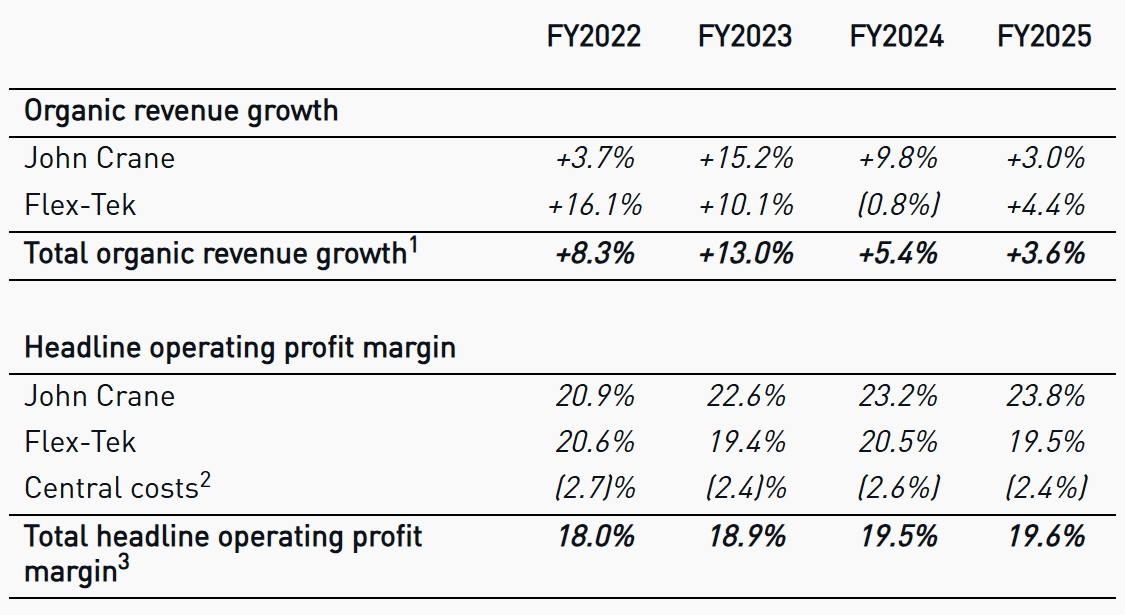
The strategic actions taken position Smiths as a focused, stronger business specializing in efficient flow management and thermal solutions. Smiths, following Completion and completion of the sale of Smiths Interconnect, will have a stronger financial profile and growth potential, with the table below showing the historical financial performance of the combined John Crane and Flex-Tek businesses:

In March 2025, Smiths set out its new enhanced medium-term financial targets that reflect this superior financial potential of Continuing Smiths following Completion:

  • Growth focused: 5-7% organic revenue growth through-cycle, with a
    21-23% headline operating profit margin and headline EPS growth of more than 10%.
  • Cash generative: ~100% operating cash conversion, with a ROCE above 20%.
  • Disciplined allocators of capital: Smiths will drive growth and productivity through RD&E, operational excellence and value-accretive acquisitions, underpinning a progressive dividend and enhanced returns to shareholders.

The Acceleration Plan to deliver productivity and capability enhancements, and a streamlined cost base, will help support the achievement of these targets. Smiths remains on track to deliver £40-45m annualised benefits in FY2027 and beyond, with approximately half expected in FY2026, for a total cost of £60-65m. Around 2/3 relates to the retained businesses and targets central costs remaining at 1.5-1.7% of revenue, following completion of the separation processes.

Industry NewsPress Release

CVC Announces the acquisition of Smiths Detection for £2bn

CVC, a private markets investment firm, announced that it has entered into an agreement to acquire Smiths Detection, a global leader in threat-detection and security-screening technologies for airports and critical infrastructure, from Smiths Group. Leveraging CVC’s extensive experience in executing corporate carve-outs and history of scaling newly independent companies, Smiths Detection is well placed to build on its strong market positions and unlock substantial long-term value.

Headquartered in the UK, Smiths Detection employs 3,400 people, including over 1,100 field service engineers and over 500 R&D professionals and operates from facilities across Europe, the US and Asia. The business has a global #1 position in aviation security — i.e. screening technology for carry-on bags, hold luggage, and air cargo at airports — where it serves 47 of the world’s top 50 airports, with both industry-leading hardware and sector-leading digital capabilities, including automated detection algorithms. Smiths Detection also serves other critical infrastructure end markets such as urban security (screening systems for government and commercial buildings, public venues and spaces ) and ports and borders (cargo and vehicle inspection) and the business has a leading niche chemical threat identification capability for defense end markets.

Dominic Murphy, a managing partner and co-head of the UK private equity team at CVC and Conor Keogh, managing director at CVC, said: “Smiths Detection’s industry-leading threat detection and security screening technologies play a crucial role in helping protect people and critical infrastructure worldwide. We look forward to supporting the business during the next phase of its growth and development through continued investment in technology innovation, high-quality engineering and best-in-class aftermarket service.”

James Mahoney, partner and head of CVC’s private equity activities in the aviation, defense & space sectors added: “We are excited to partner with Jérôme de Chassey and his team. Smiths Detection’s strong market positions, anchored by its global leadership in aviation, create a compelling platform for long-term value creation.”

The transaction is subject to customary regulatory approvals and is expected to close in the second half of 2026. Barclays acted as financial advisor and Latham & Watkins acted as legal counsel to CVC. 

The investment will be made through CVC Capital Partners IX.

Cambodia Opens a New Chapter in Air Travel with Technology-Driven Techo International Airport

Air travel in Southeast Asia is growing at a rate well above the global average. According to SITA’s latest Travelers’ Voice, Passenger IT Insights 2025 report, nearly two in three travelers now expect faster airport processing and more control over their journey. Cambodia has responded with Techo International Airport (KTI) — a landmark project by Cambodia Airport Investment Co. Ltd. (CAIC), a subsidiary of Overseas Cambodian Investment Corporation, in partnership with the State Secretariat of Civil Aviation (SSCA) — bringing world-class infrastructure and SITA’s next-generation airport systems to the country’s new capital gateway.

Replacing the former Phnom Penh International Airport, Techo International Airport represents the centerpiece of Cambodia’s aviation strategy to attract international visitors and boost trade. The airport can handle 13 million passengers annually in Phase 1, with capacity expected to increase to 30 million in Phase 2 and 50 million in Phase 3.

For the first time in Cambodia, travelers can enjoy a fully digital airport experience from check-in to boarding. With SITA’s self-service kiosks, automated bag drops, and eGates, passengers can move through the airport with greater speed and ease. SITA Bag Manager tracks every bag in real time, reducing mishandling and giving travelers peace of mind through full baggage visibility.

Behind the scenes, SITA’s Airport Management System and Airport Vision keep operations running smoothly by giving airport teams real-time insights they can act on. These intelligent platforms help streamline workflows, anticipate disruptions, and enable faster, data-driven decisions to keep flights on schedule and passengers informed. Together, these technologies create a smarter, more connected airport ecosystem — one where efficiency, accuracy, and passenger satisfaction come together seamlessly.

“Southeast Asia’s aviation market is growing at record pace, but that growth brings complexity,” said Sumesh Patel, president, Asia Pacific, SITA. “Techo International Airport shows how technology can turn that challenge into opportunity. By adopting scalable, data-driven systems from day one, CAIC has created an airport that can grow sustainably and be resilient in the face of disruption while delivering a world-class experience for every traveler.”

29 airlines are already connected through SITA’s Common Use Terminal Equipment (CUTE) platform, ensuring seamless collaboration between airlines, ground handlers, and airport operations. The integrated setup also includes Local Departure Control System (LDCS), Pax Check, Pax Locate, and SITATEX messaging — all designed to connect airport stakeholders reliably and securely.

As one of the region’s newest greenfield airports, Techo International Airport stands as a model for the next generation of smart, scalable, and sustainable aviation infrastructure in Southeast Asia — ready to meet tomorrow’s travelers today.